The moment you step off the vehicle, the bush changes completely.
The engine noise fades. The dust settles. And suddenly you can hear everything — your own heartbeat, the crack of a twig under your boot, the alarm call of a francolin that has already spotted you. A breeze carries the scent of wild sage and buffalo dung. The grass is taller than you expected. The ground is uneven. You are no longer watching the wild from the safety of a steel box. You are in it.
I have been a trail guide for most of my adult life, and I can tell you with absolute certainty: there is no experience on earth quite like walking through the African bush. Not driving, not flying, not boating — walking. On foot, at the pace your body was designed for, with nothing between you and the wilderness but your senses and your guide.
At Bakubung Safaris & Tours, we believe that walking safaris represent the most honest form of safari there is. No engine to mask your presence, no elevated seat to create distance. Just you, the earth, and whatever the bush chooses to show you. This is our complete guide to walking safari tours in Africa for 2026.
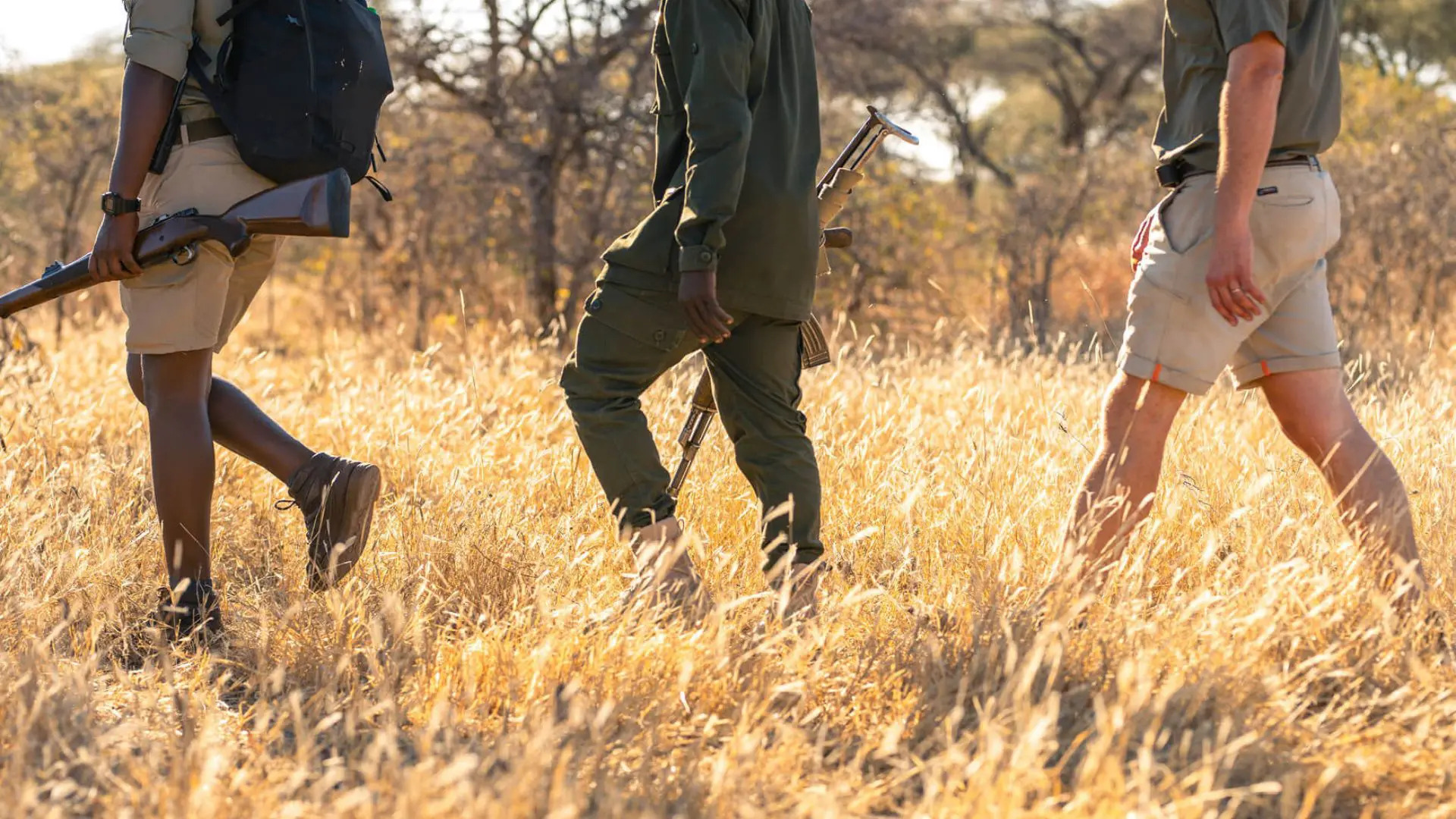 A small group walking single-file through the golden African savanna with an armed guide leading the way
Why Walking Safaris Are the Purest Way to Experience Africa
A game drive is spectacular. But a walking safari is something else entirely — something deeper, slower and more intensely alive.
Your senses wake up. On a vehicle, you rely almost entirely on sight. On foot, everything activates. You smell the musky territorial marking of a leopard before you see the scratch marks on the tree. You feel the vibration of a distant herd through the soles of your boots. You hear the difference between a wind-rustle and an animal-rustle. Your body remembers what it was built for.
You notice what the vehicle misses. From a Land Cruiser, you see the Big Five and the big landscapes. On foot, you discover the tiny universe between your boots: dung beetle highways, perfectly engineered spider webs, the fossilised track of a dinosaur ancestor pressed into ancient rock, a chameleon changing colour on a branch at eye level. The bush is full of miracles that only reveal themselves to people moving slowly.
The primal connection is real. There is a reason your pulse quickens when you walk through elephant country on foot. For two million years, your ancestors navigated this landscape without vehicles, without fences, without phones. A walking safari reconnects you to that ancient awareness. It is not fear exactly — it is aliveness. Every trail guide I know calls it the same thing: presence.
The rhythm is meditative. Walking in single file through the bush, in silence, for two or three hours — it does something to your mind that no spa or meditation app can replicate. The thoughts that seemed urgent at home dissolve. The only thing that matters is the next footstep, the next sound, the next breath. Many guests tell me their walking safari was the most peaceful experience of their lives.
How Walking Safaris Work — And Why They Are Safe
I understand the hesitation. Walking through country shared with lions, elephants and buffalo sounds dangerous. Let me demystify it.
Every walking safari is led by a qualified, armed trail guide. In South Africa, walking trail guides must hold a FGASA (Field Guides Association of Southern Africa) Trails Guide qualification — one of the most rigorous guiding certifications in the world. They are trained in animal behaviour, firearm handling, first aid and risk management. Most have spent thousands of hours on foot in Big Five territory.
You walk with a backup. Most walking safaris include a second guide or tracker walking at the rear of the group, carrying a rifle and watching the flanks.
The formation is deliberate. You walk in single file behind the lead guide, maintaining silence and following instructions. Before every walk, you receive a thorough safety briefing covering what to do if you encounter dangerous game (spoiler: you freeze, stay calm, and let the guide handle it).
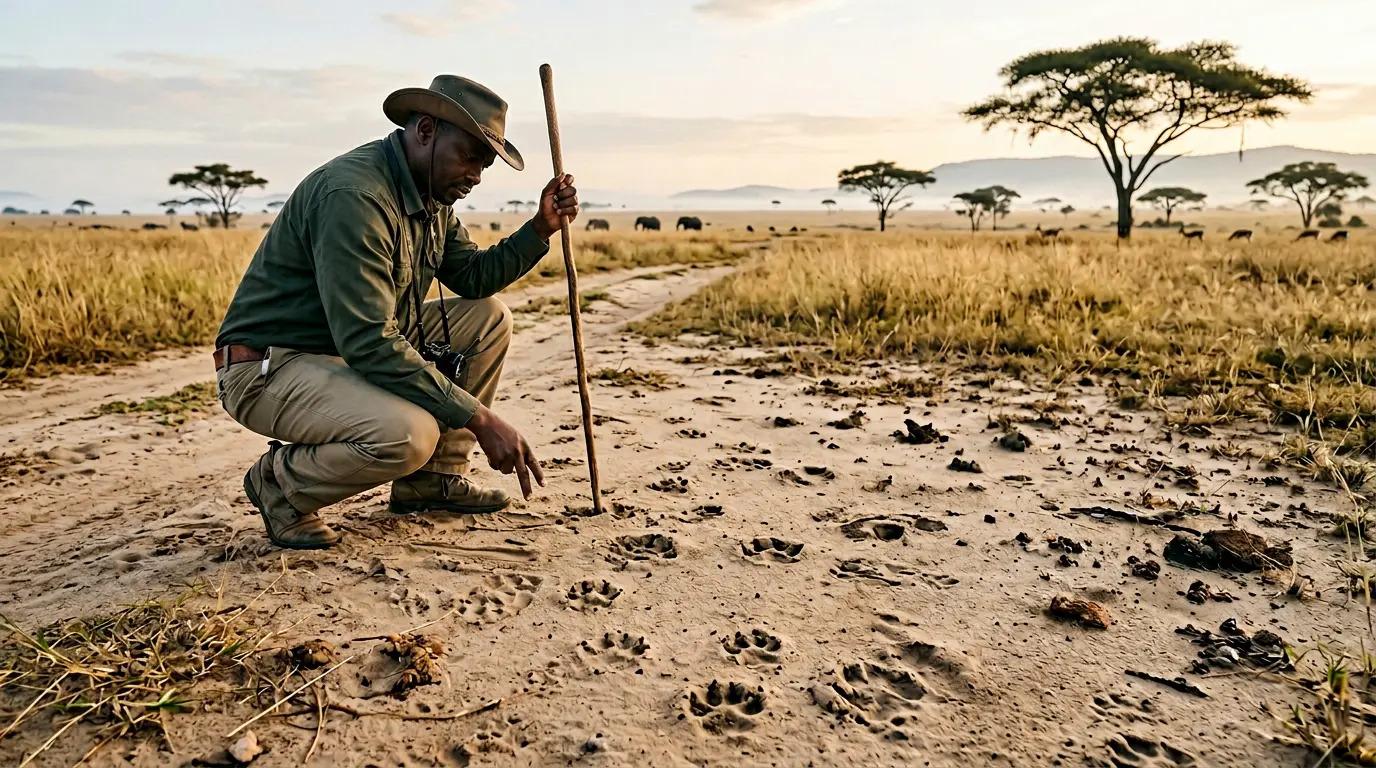 A safari guide crouching to examine animal tracks on the ground, showing the intimate detail of a walking safari
You do not approach dangerous animals on foot. This is the biggest misconception. A walking safari is not about stalking lions. It is about reading the landscape — following tracks, interpreting signs, understanding the ecosystem from the ground up. If you encounter large dangerous game, the guide will assess the situation and either observe from a safe distance or calmly redirect the group. Confrontation is never the goal.
The safety record is exceptional. Walking safaris have been conducted in Southern and East Africa for decades, with an outstanding safety record. The guides who lead these trails are among the most experienced and competent professionals in the safari industry.
Best Destinations for Walking Safaris
Kruger Wilderness Trails, South Africa
The Kruger National Park pioneered multi-day wilderness trails in the 1970s, and they remain the gold standard. Seven designated Wilderness Trails operate in remote, vehicle-free zones of the park. You spend three or four nights in a basic bush camp — canvas tents, bucket showers, paraffin lamps — walking twice daily with a trails guide.
These are not luxury experiences. They are raw, immersive and profoundly transformative. The Olifants, Wolhuter and Sweni trails are legendary among trail enthusiasts. If you want to understand what the bush was before roads and lodges, Kruger's Wilderness Trails are where you go.
Waterberg, South Africa
The Waterberg is a hidden gem for walking safaris. This malaria-free region north of Johannesburg features dramatic sandstone cliffs, ancient rock formations and Big Five reserves set in mountainous terrain that is perfect for walking.
The elevation changes give you sweeping views, the geology is fascinating, and the lack of malaria risk makes it accessible to travellers who prefer not to take prophylactics. Several private reserves in the Waterberg offer excellent guided walks ranging from half-day excursions to multi-day trails.
Pilanesberg Game Reserve, South Africa
For a walking safari that fits into a day trip, Pilanesberg is hard to beat. Just two hours from Johannesburg, the reserve offers guided bush walks inside the Big Five reserve, led by qualified trail guides. The walks typically last two to three hours and focus on tracking, plant identification and smaller wildlife — the details you miss from a vehicle.
Pilanesberg walks are an excellent introduction to walking safaris for first-timers, and they pair beautifully with a game drive for the complete experience.
Botswana's Okavango Delta
The Okavango Delta offers a unique walking experience: island walks. Between mokoro (dugout canoe) trips through the channels, you disembark on palm-fringed islands and walk through open floodplains with your guide. The combination of water and land exploration is extraordinary — you might track buffalo spoor on an island in the morning and glide past hippos by mokoro in the afternoon.
Botswana's guides are world-class, and the delta's island ecosystem provides a walking experience unlike anywhere else on the continent.
Zambia — South Luangwa
Zambia's South Luangwa Valley is widely regarded as the birthplace of the modern walking safari. The legendary Norman Carr pioneered guided walks here in the 1950s, and the tradition continues with some of the finest trail operators in Africa.
South Luangwa walks are typically mobile — your camp moves with you, so each day you walk to a new location and arrive to find your tent pitched and a hot shower waiting. The wildlife density is staggering, the guides are exceptional, and the experience is as close to the original walking safari as you can get.
Types of Walking Safari Experiences
Walking safaris come in many forms, and the right one depends on your fitness, comfort preferences and sense of adventure.
Multi-day wilderness trails. Three to four nights in a basic bush camp with twice-daily walks. Minimal comfort, maximum immersion. This is the purest form of walking safari — no vehicles, no electricity, no distractions. Kruger's Wilderness Trails and Zambia's mobile walking safaris fall into this category.
Day walks from a lodge. A two-to-three-hour guided walk in the morning, then return to your lodge for brunch, a swim and an afternoon game drive. This is the most popular option because it combines the intimacy of walking with the comfort of a lodge. Most private safari lodges in the Greater Kruger and Botswana offer morning walks as part of the activity programme.
Mobile walking safaris. Your camp moves ahead of you each day, so you walk from one camp to the next through changing landscapes. This is the classic Zambia format and offers the adventure of a multi-day trail with slightly more comfort than a static bush camp.
Community and cultural walks. Not all walks are about wildlife. Some of the most rewarding walking experiences involve visiting local communities, learning about traditional plant use, and understanding how people have coexisted with wildlife for generations. These walks add a human dimension to the safari story.
What to Expect on the Trail
A typical day on a multi-day walking trail:
- 05:00 — Wake-up call. Coffee and rusks around the campfire as the sky lightens.
- 05:30 — Depart on the morning walk. Three to four hours through the bush, stopping to examine tracks, identify birds, and observe whatever the bush offers.
- 09:30 — Return to camp. A full brunch cooked over the fire.
- 10:00–15:00 — Siesta. Read, sleep, journal, swim if there is a river nearby. The heat of the day is yours.
- 15:30 — Shorter afternoon walk, two hours or so, often focused on a specific area — a waterhole, a rocky outcrop, a riverine forest.
- 17:30 — Return to camp. Sundowners around the fire.
- 18:30 — Dinner under the stars. Stories from the trail. Early to bed.
Fitness level: Moderate. You do not need to be an athlete, but you should be comfortable walking for three to four hours on uneven terrain in warm conditions. If you can manage a decent hike at home, you can manage a walking safari. Guides set a gentle pace and stop frequently.
What to wear and bring: Neutral-coloured clothing (khaki, olive, brown — nothing bright), sturdy closed-toe walking shoes or boots that you have already broken in, a wide-brimmed hat, sunscreen, insect repellent, and a small daypack for water and a camera. Leave the perfume and aftershave at home — the bush has a better smell.
Sample Itineraries with Real 2026 Pricing
Prices are per person in South African Rand and vary by season and operator.
4-Day Kruger Wilderness Trail
- Days 1–4: Join a SANParks Wilderness Trail in a remote section of Kruger. Walk twice daily with a FGASA trails guide. Sleep in a basic bush camp. All meals and guiding included.
Kruger Wilderness Trails range from R8,000 to R15,000 per person — extraordinary value for one of the most authentic bush experiences in Africa. They book out months in advance, so plan early.
3-Day Waterberg Walking Safari
- Days 1–3: Based at a private reserve in the Waterberg. Daily guided walks through Big Five territory with dramatic cliff and mountain scenery. Return to a comfortable lodge each evening.
This malaria-free walking safari ranges from R6,000 to R12,000 per person depending on the lodge, making it one of the most accessible options for walkers based in or visiting Gauteng.
7-Day Zambia Walking Safari (South Luangwa)
- Days 1–7: A mobile walking safari through the South Luangwa Valley. Walk between camps, each pitched in a new location. World-class guiding, incredible wildlife density, and the spirit of Norman Carr.
This flagship walking safari ranges from R35,000 to R60,000 per person including internal flights from Lusaka — a once-in-a-lifetime experience for serious trail enthusiasts. For those exploring the best African safari tours, South Luangwa deserves a place on the list.
How Bakubung Makes It Happen
We do not send you into the bush with just anyone. Our walking safaris are built on three principles:
- The finest guides. We work exclusively with FGASA-qualified trails guides who have thousands of hours of foot-trail experience. Your safety and education are in the best hands in the industry.
- Matched to your level. We listen to your fitness, comfort preferences and experience, then recommend the trail that fits. A first-timer does not belong on a hardcore Zambia mobile trail, and an experienced walker does not want a two-hour stroll — we get the match right.
- Every detail handled. Permits, transfers, equipment lists, dietary requirements, pre-trail briefings — we take care of it all so you can focus on what matters: putting one foot in front of the other.
Whether you want a gentle introduction to walking in Pilanesberg or a week-long immersion in the Luangwa Valley, we will design a trail that changes the way you see the wild forever.
Put Down the Binoculars. Lace Up Your Boots.
There is a version of safari that most people never experience — one where the engine is off, the road is gone, and the only thing between you and the wilderness is the ground beneath your feet.
A walking safari will not give you the speed of a game drive or the comfort of a luxury lodge. What it will give you is something rarer: the feeling of being fully, completely, honestly alive in a landscape that has looked this way for a million years.
The bush is waiting to meet you properly. Not from behind a windscreen, but face to face, eye to eye, heartbeat to heartbeat.
When you are ready to take the first step, reach out to our team and let us find the trail that was made for you. Your boots are all you need.
Walk gently. The bush will show you everything.