Most people come to Africa for the lions. And then, somewhere on the second morning, a lilac-breasted roller lifts off a dead branch right beside the vehicle — turquoise, violet, cinnamon and sky-blue all catching the light at once — and I watch grown adults who came for the Big Five completely forget the lions ever existed.
I have been guiding in the African bush for many years, and I will tell you a secret the brochures never mention: the birds are the best-kept treasure of the safari. There are only so many big cats to find on any given morning, but the sky and the trees and the water’s edge are never still. There is always something with feathers doing something extraordinary — a fish eagle throwing its head back to call, a bee-eater snatching a dragonfly mid-air, a secretary bird stamping a snake to death in the grass. Once your eye learns to notice them, a safari never has a dull moment again.
Africa is, quite simply, the greatest birding continent on the planet. Southern Africa alone hosts over 900 species; the continent well over 2,300. And at Bakubung Safaris & Tours, some of the most rewarding trips we run are for birders — from serious life-listers with scopes and notebooks to families who just want to know the name of that impossibly colourful thing on the branch. This is our complete, honest guide to birdwatching safari tours in Africa for 2026.
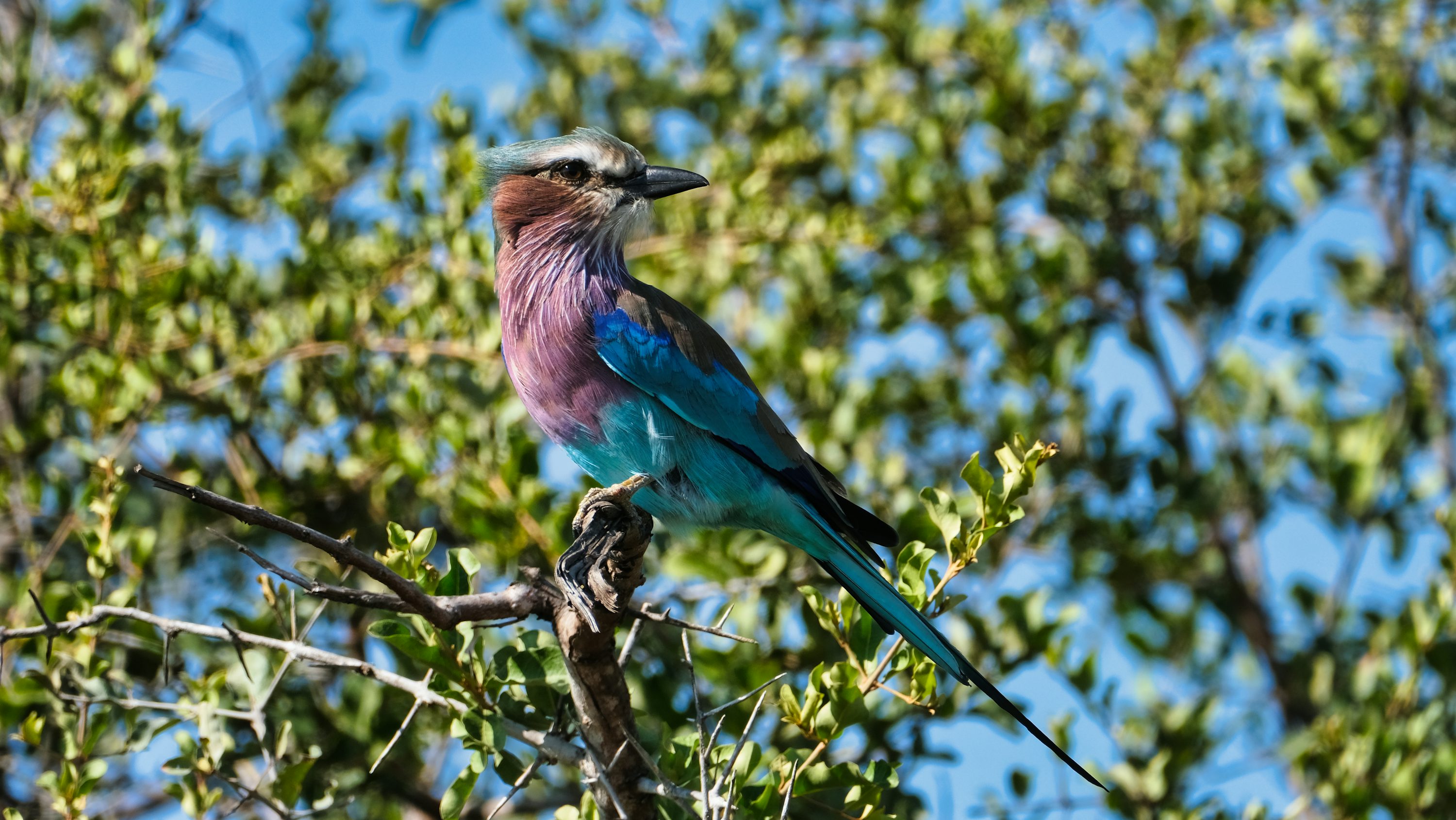 A vibrant lilac-breasted roller perched on a branch against a blue sky in the African bushveld
Why Africa Is the World’s Ultimate Birding Destination
The sheer diversity is staggering. Kruger National Park alone records over 500 bird species — more than many entire countries. Add the wetlands of the Okavango Delta, the coastal forests, the highveld grasslands and the arid Kalahari, and you have a range of habitats that supports an astonishing spread of birdlife within a single trip.
The birds here are spectacularly beautiful. This is not the subtle brown-bird watching some people imagine. Africa gives you rollers in five shades of blue, carmine bee-eaters that turn a riverbank scarlet, malachite kingfishers like flying jewels, and lovebirds, sunbirds, starlings and go-away-birds in colours that seem almost invented.
You do not have to choose between birds and big game. This is the joy of an African birding safari — you are watching for a Verreaux’s eagle-owl and a leopard walks past. The same game drive that produces elephants and lions produces ground hornbills and saddle-billed storks. You get everything at once.
It is wonderfully beginner-friendly. You do not need to be an expert. A good guide, a decent pair of binoculars and a field guide (or an app) is all it takes to start ticking off species — and the learning curve is part of the fun.
The “Big Six” of African Birding
Just as the mammals have their Big Five, birders chase a celebrated “Big Six” — the most sought-after, charismatic species. Ticking off all six is a genuine badge of honour:
- Lilac-breasted Roller — the unofficial national bird of the safari, and the most photographed bird in Africa for good reason.
- Saddle-billed Stork — a tall, striking wader with a red-black-and-yellow bill, usually stalking the shallows.
- Kori Bustard — the heaviest flying bird in the world, striding across the open plains.
- Martial Eagle — Africa’s most powerful eagle, capable of taking down a small antelope.
- Southern Ground Hornbill — a turkey-sized, red-faced bird that walks the bush in family groups; sadly endangered, so every sighting matters.
- Pel’s Fishing Owl — the holy grail. A huge, ginger, fish-eating owl of the waterways. See one and you will dine out on the story for years.
Find all six and you have earned true bragging rights. I still remember the exact riverbend where I showed my first group a Pel’s fishing owl at dusk — nobody spoke for a full minute.
The Best Birding Regions in Southern Africa
Kruger National Park & the Lowveld
The crown jewel. Over 500 species across savanna, riverine forest and wetland. The northern section around Pafuri and the Luvuvhu River is legendary — a birding hotspot within a birding hotspot, home to specials like the racket-tailed roller and Pel’s fishing owl. Start planning at our Kruger National Park guide.
Pilanesberg National Park
Only a couple of hours from Johannesburg, Pilanesberg sits in a fascinating transition zone where the dry Kalahari species meet the moist lowveld species, producing an unusually rich bird list for its size. Perfect for a birding day trip or a first taste. See our Pilanesberg guide.
The Okavango Delta, Botswana
A water-birder’s heaven. Slaty egrets, wattled cranes, African skimmers and Pel’s fishing owls thrive in this vast wetland. A mokoro (dugout canoe) glide through the reeds is one of the finest birding experiences on earth. Explore Botswana with us.
The Wetlands & Coast
From the flamingo-pink pans to the coastal estuaries, Southern Africa’s wetlands deliver flamingos, pelicans, herons, kingfishers and a wealth of migratory waders. Combine bush and water for the fullest possible list.
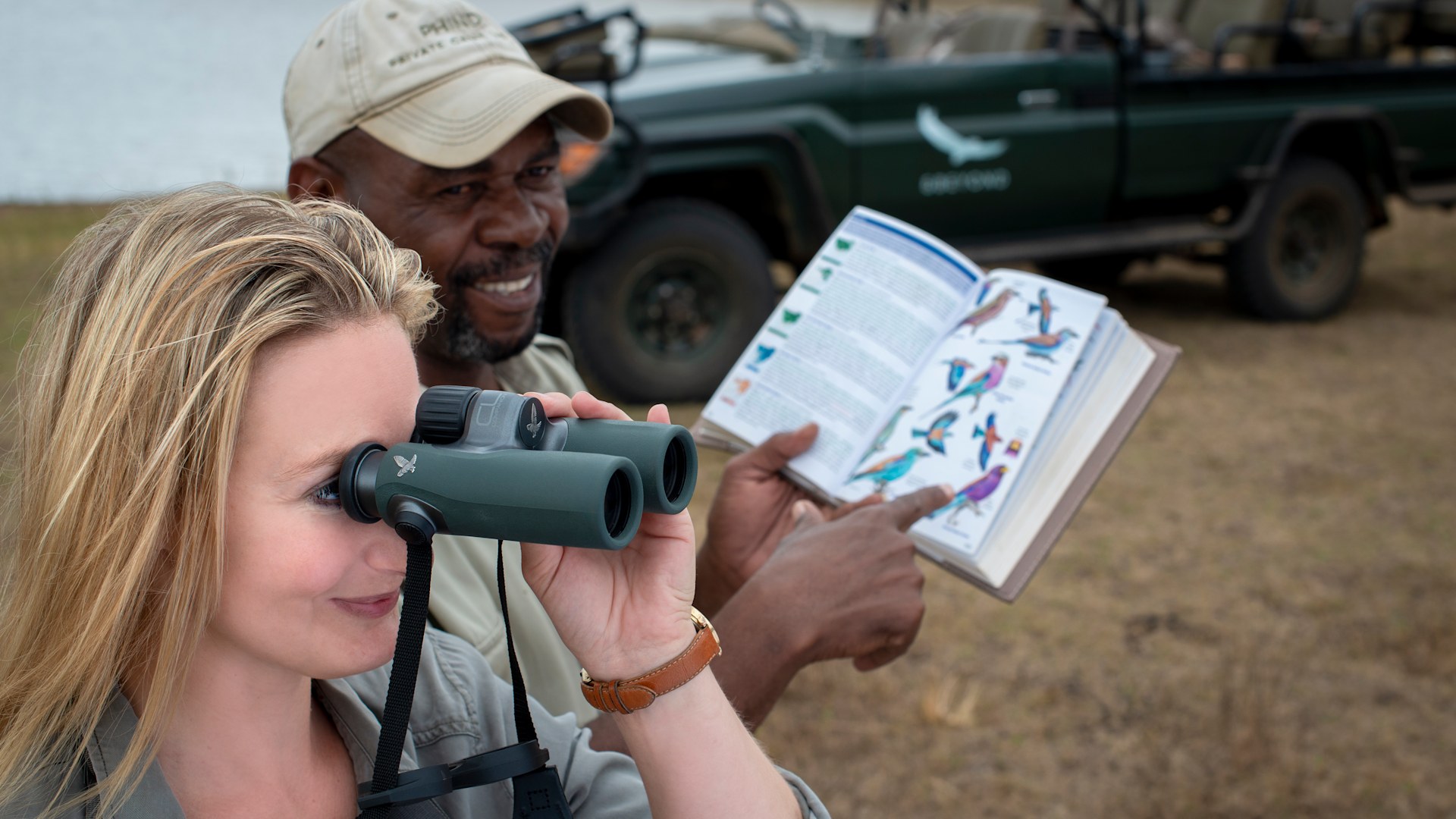 Safari birdwatchers using binoculars and a bird field guide on a game drive in Africa
When to Go: Timing Your Birding Safari
Season matters enormously for birders — more than for general game viewers.
November to April (the green season) is the birding prime time. This is when the Palearctic and intra-African migrants arrive — European rollers, cuckoos, storks, bee-eaters and warblers pour in. The resident birds burst into breeding plumage, the males singing and displaying at their most colourful, and the summer rains bring the bush alive. If your priority is birds, this is your window. The trade-off is thicker vegetation and hotter, wetter days.
May to September (the dry season) is better for combining birds with big game. The bush thins out, animals concentrate at waterholes, and general game viewing peaks. You lose the migrants, but the resident specials are all still there and easier to spot against bare branches. For a first-timer wanting both superb birding and classic Big Five action, this is the sweet spot. Read our detailed best time to visit Kruger guide for month-by-month advice.
My honest recommendation? If you are a dedicated birder, come in the green season for the migrants and the breeding plumage. If you want the full safari experience with excellent birding on the side, come in the dry season.
What to Pack for a Birding Safari
Getting your kit right transforms the experience:
- Binoculars — the single most important item. A quality 8x42 pair is the birder’s standard: bright, steady and wide enough to find birds quickly. Never rely on your phone.
- A field guide or app — a good Southern African bird guide (Sasol or Roberts) or an app like Merlin or BirdLasser. Identifying your own sightings is half the joy.
- A camera with a decent zoom — a 300mm lens or longer if you want photographs, though even a superzoom compact will do.
- Neutral, muted clothing — khaki, olive and brown. Bright colours and white spook birds.
- A wide-brimmed hat, sunscreen and a light rain jacket for the green season.
- Patience and quiet — the best birding reward stillness. Some of my finest sightings came to those who simply waited.
What a Birding Safari Costs (Honest 2026 ZAR Pricing)
Here is straight-talking guidance on what to budget, in South African Rand:
- Pilanesberg birding day trip from Johannesburg — from around R1,499 per person, including transport, park fees and a guided drive. A superb, affordable introduction.
- 3-day guided Kruger birding safari — from around R8,999 per person sharing, including accommodation, meals, park fees and a specialist-minded guide. Ideal for building a serious list.
- 5 to 7-day cross-border birding expedition (Kruger plus Botswana’s waterways) — from around R18,999 per person, for the birder who wants the full sweep of habitats and the best shot at the Big Six.
As always, the exact price depends on season, group size and lodge choice — and a larger group brings the per-person cost down considerably. For our full pricing philosophy, see our budget safari guide.
Why Bird With Bakubung
A great birding safari lives or dies on the guide. Our guides are trained to recognise hundreds of species by sight and by call — which is how we find the shy, skulking specials that separate a good bird list from a great one. We travel slowly, we stop often, and we understand that for a birder, ten minutes with a Pel’s fishing owl beats racing off to the next lion. We tailor the pace, the route and the timing to what you most want to see, whether that is a full life-list assault or a gentle, colourful introduction for the family.
Frequently Asked Questions
Do I need to be an experienced birder to enjoy a birding safari? Not at all. Some of our most delighted birding guests started the trip unable to tell a starling from a stork. A good guide and a pair of binoculars is all you need — the enthusiasm builds itself.
How many species could I realistically see? On a well-run 3-day Kruger trip in the right season, 150 to 200+ species is very achievable. Dedicated birders on longer, multi-habitat expeditions regularly top 300.
Can I combine birdwatching with Big Five game viewing? Absolutely — and most of our guests do. On an African safari the two go hand in hand; the same drive delivers both. The dry season is best if big game is an equal priority.
What is the best single destination for a first birding safari? Kruger National Park, without hesitation — the diversity, the accessibility and the chance to combine birds with big game make it unbeatable for a first trip.
Ready to chase your first lilac-breasted roller? Whether you are a serious lister or simply want to fall in love with the colours of the African sky, we will build a birding safari perfectly paced for you. Message us on WhatsApp or start your booking today — and let us show you why, once you start watching the birds, a safari is never the same again. 🦩