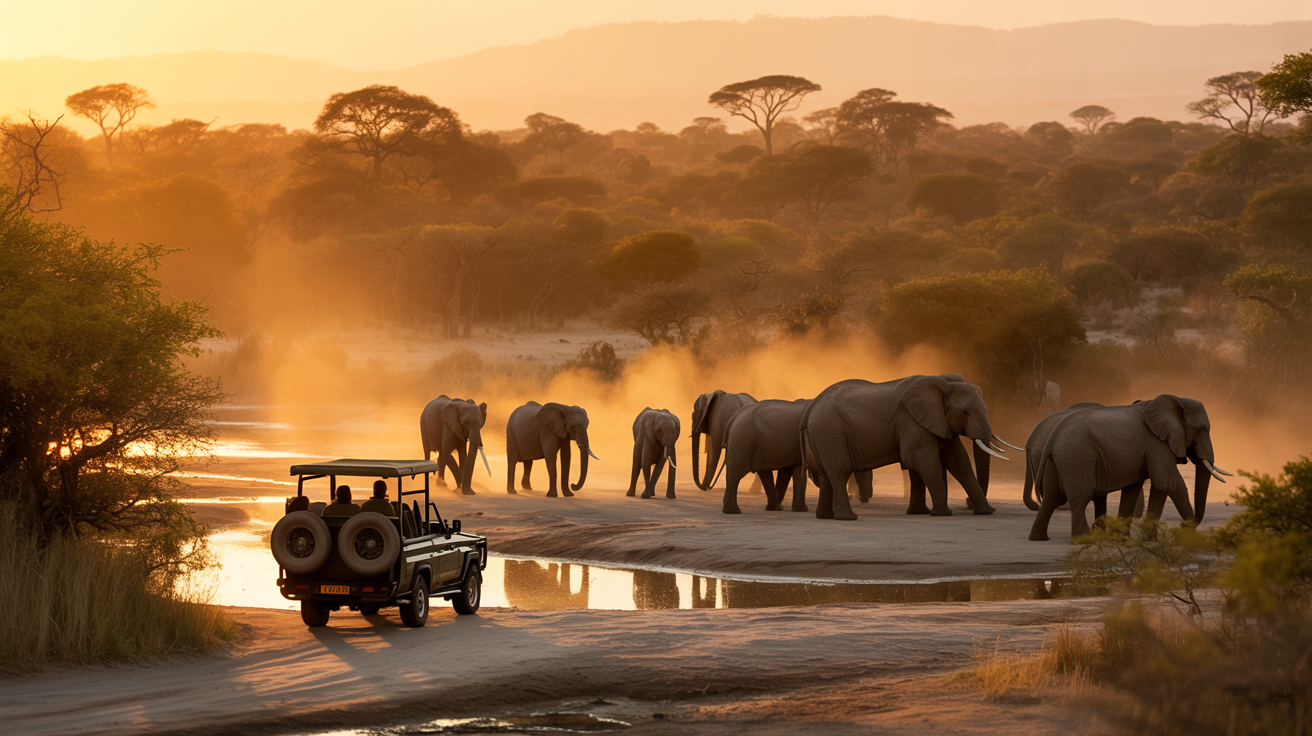
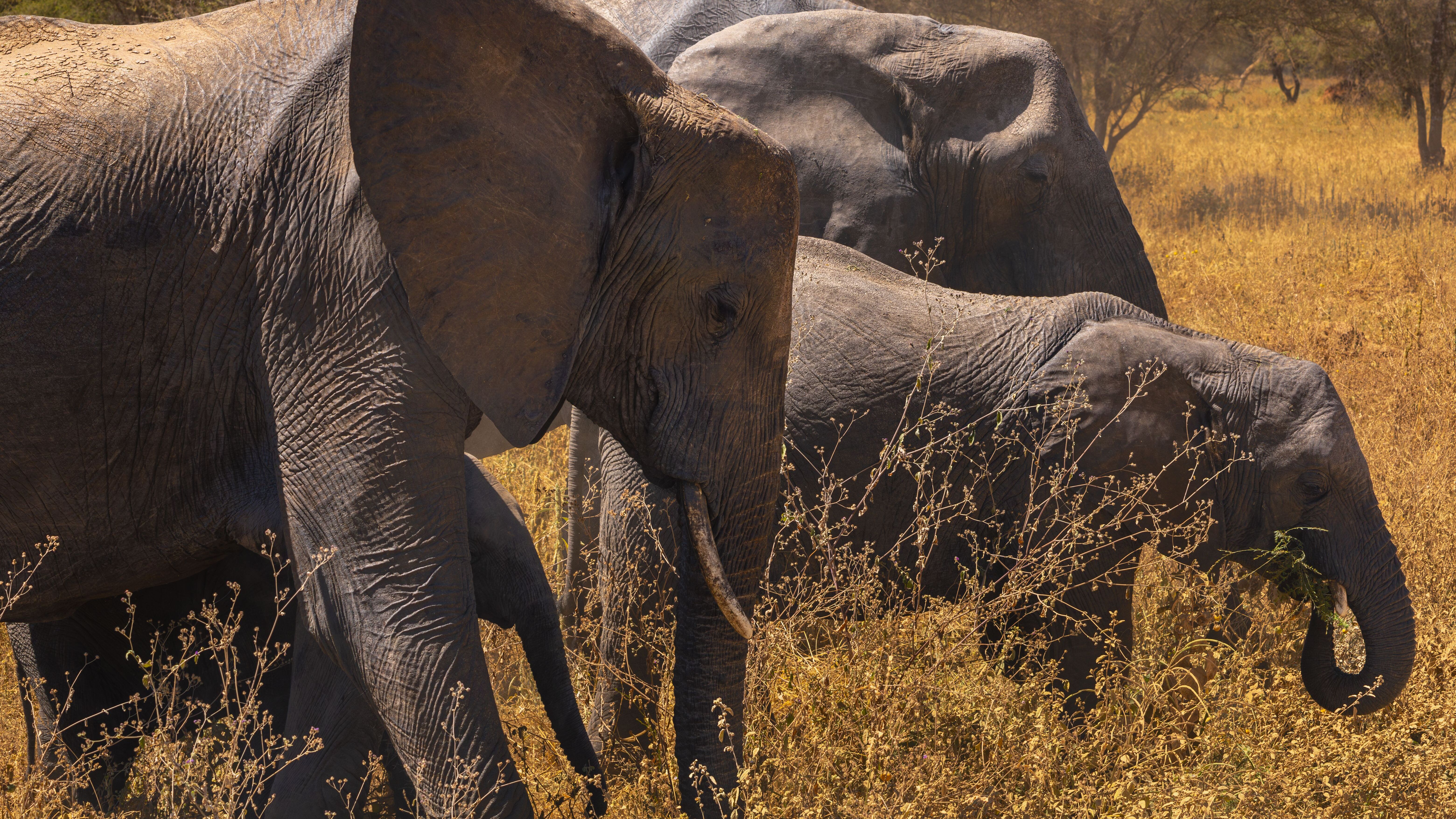
 Elephants grazing in golden savanna grassland — the quintessential South African Big Five safari experience
It is the single most asked question in South African safari tourism: "Should I go to Kruger or Pilanesberg?"
I hear it every week — from first-time visitors landing at OR Tambo, from couples planning honeymoons, from solo adventurers scrolling through comparison articles at two in the morning. And honestly, most of those comparison articles get it wrong. They either romanticise Kruger as the only real safari or dismiss Pilanesberg as "Kruger Lite." Neither is true.
As a Johannesburg-based safari operator who runs trips to both parks year-round, I have spent hundreds of days in each reserve. I have watched a coalition of male lions take down a buffalo in Kruger's Satara region at dawn, and I have sat in stunned silence as a black rhino cow walked her calf across the road at Pilanesberg's Mankwe Dam in the afternoon sun. Both are unforgettable. Both are deeply, authentically African.
But they are very different experiences. And the right choice depends entirely on your trip — your time, your budget, your priorities, and what you want to feel when you leave.
This is the honest comparison. No filler, no favourites, just the truth from someone who loves both parks.
The Quick Answer (For Those in a Hurry)
| Factor | Kruger National Park | Pilanesberg Game Reserve |
|---|---|---|
| Distance from Joburg | 4–5 hours drive | 2–2.5 hours drive |
| Size | 19,485 km² | 572 km² |
| Big 5 present | Yes (all five) | Yes (all five) |
| Malaria risk | Yes (low-moderate) | No (malaria-free) |
| Self-drive | Excellent road network | Good, compact road network |
| Day trip possible | Not ideal | Yes — perfect for day trips |
| Budget (day visit) | From R440 per person | From R120 per person |
| Guided safari cost | From R3,500 per person | From R1,800 per person |
| Accommodation range | SANParks rest camps to ultra-luxury lodges | Budget chalets to five-star resorts |
| Best for | Multi-day immersion, variety, sheer scale | Day trips, weekend getaways, families |
Still reading? Good. Let us dig into what really matters.
Distance & Accessibility: The Dealbreaker for Many
Let me be direct: distance is the number one reason most visitors choose one park over the other, and it should be.
Pilanesberg sits roughly 2 to 2.5 hours northwest of Johannesburg along the N4 highway toward Sun City. The road is excellent, mostly dual carriageway, and the drive is relaxed. You can leave Joburg at 5am, be at Bakgatla Gate by 7am for the best dawn game driving, and be back home for dinner. It is the only Big Five reserve in South Africa where a genuine day trip from Johannesburg is practical and enjoyable.
Kruger National Park is a different proposition. The southern gates (Malelane, Crocodile Bridge, Numbi) are roughly 4 to 5 hours from Johannesburg by car, and the popular central section around Satara is closer to 5.5 hours. While the road (N4 then N12/R40) is good, it is a proper journey. A day trip to Kruger from Johannesburg is technically possible but frankly exhausting — you would spend more time driving than game viewing. Kruger really comes alive with a two-night minimum stay, ideally three or more.
There are also daily flights to Kruger Mpumalanga International Airport (KMIA) near Nelspruit and to Skukuza Airport inside the park, but these add cost (from R2,500 return) and logistics.
Our honest take: If you have only one day, Pilanesberg is the clear winner. If you have two or more nights, Kruger opens up dramatically and becomes the stronger experience. That is not a slight against Pilanesberg — it is simply geography.
Size & Wilderness Feel: David and Goliath
This is where the comparison gets interesting.
Kruger covers 19,485 km² — nearly the size of Israel. It is one of the largest game reserves on the continent, with ecosystems ranging from riverine forest to open grassland to dense mopane woodland. You can drive for hours and not see another vehicle. On a quiet Wednesday morning in the northern Pafuri section, you might go an entire game drive without seeing another human being. That sense of wilderness immensity is addictive, and it is something very few places on Earth can match.
Pilanesberg covers 572 km² — smaller, certainly, but let me put that in perspective: it is still larger than many famous reserves including Hluhluwe-iMfolozi (960 km² combined) and most private Kruger concessions. Pilanesberg sits in a collapsed volcanic crater — a ring of ancient alkaline hills that create a stunningly unique landscape of bushveld, grassland, and scattered rocky outcrops with Mankwe Dam shimmering at the centre. The volcanic geography funnels wildlife into concentrated areas, which paradoxically means your chances of seeing game per kilometre driven are often higher than in Kruger's vast expanse.
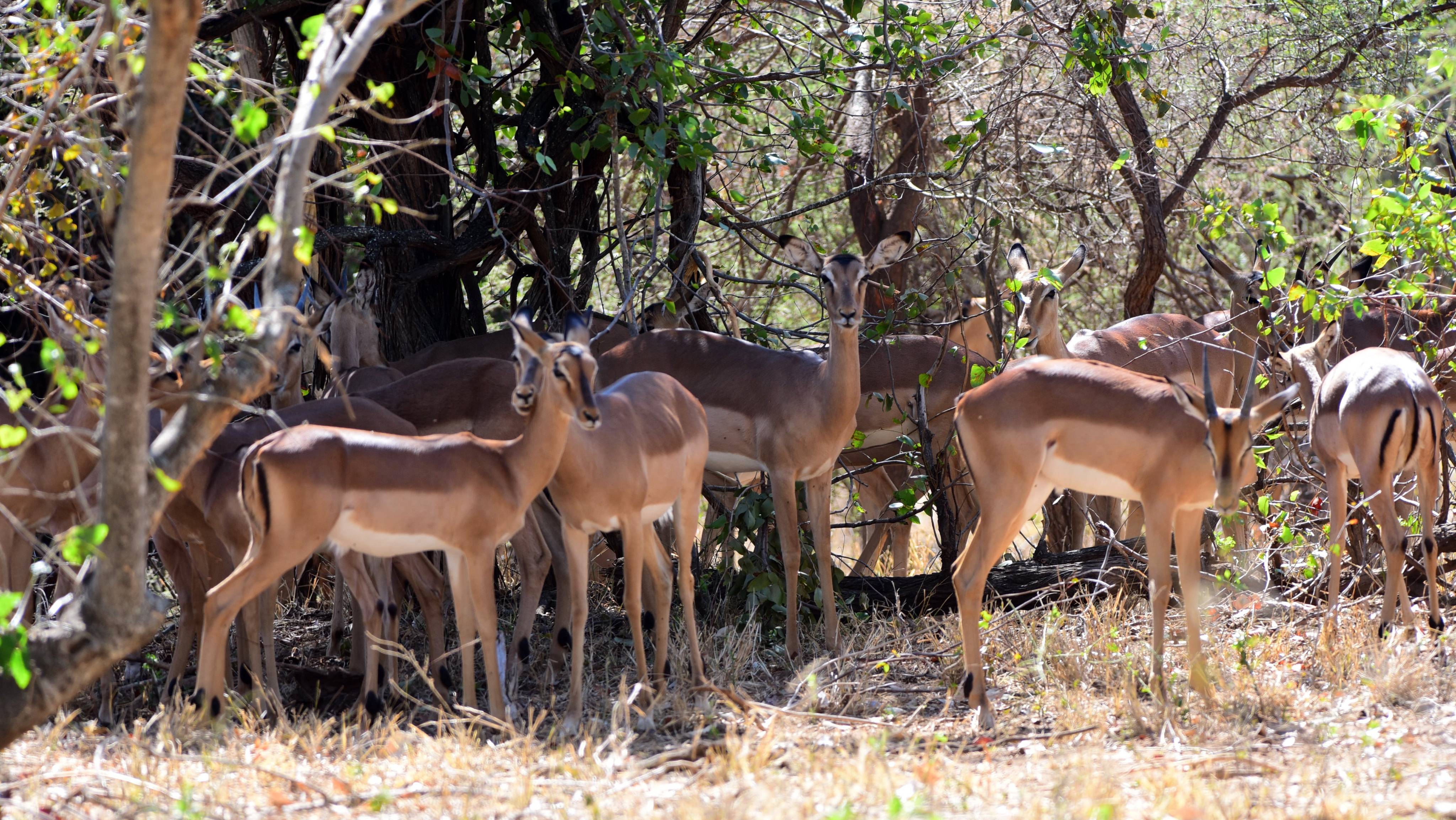 Impala herd sheltering in the distinctive bushveld of Pilanesberg Game Reserve — the volcanic landscape concentrates wildlife into compact zones
But here is the trade-off: Pilanesberg's compact size means you may encounter the same elephant herd twice on a loop drive, and on busy weekends (especially school holidays), the park can feel crowded at popular waterholes. Kruger's sheer scale means you can always find solitude — just drive north.
Our honest take: Kruger wins on raw wilderness. Pilanesberg wins on concentrated, efficient game viewing. If feeling truly remote is important to you, choose Kruger. If you want to maximise sightings in limited time, Pilanesberg often delivers better.
Big Five & Wildlife: Who Has Better Sightings?
Both parks are home to all of the Big Five — lion, leopard, elephant, buffalo, and rhino. But the sighting dynamics are different.
Lions
Kruger has an estimated 1,600–2,000 lions spread across its vast territory. The central region (Satara, Orpen) is Big Cat Country — open savanna with huge herds of prey species and multiple prides. On a good three-day Kruger trip, your chances of seeing lions are roughly 80–90%, and multiple sightings are common.
Pilanesberg has a smaller but healthy lion population (around 30–40 lions in several prides). Because the park is compact, lions are seen regularly, but sightings are less predictable. On a full-day Pilanesberg trip, your chance of lions is roughly 40–60% — still good, but not guaranteed.
Leopard
The elusive cat is your toughest tick in either park. Kruger's southern section and the adjoining Sabi Sands private reserve offer the best leopard viewing in Africa (Sabi Sands alone has a near-100% sighting rate over a two-night stay). In Kruger main camp areas, a focused multi-day trip gives you roughly a 30–50% chance.
Pilanesberg has leopards, but they are shy and sightings are uncommon — perhaps 10–20% on a given day. If leopard is your dream sighting, Kruger (or better yet, Sabi Sands) is where to go.
Elephant
Both parks are excellent for elephant. Kruger has over 17,000 elephants and you will see them almost every time you visit. Pilanesberg has several hundred elephants and sightings are very reliable, especially around Mankwe Dam and Lengau Dam. This one is effectively a tie.
Rhino
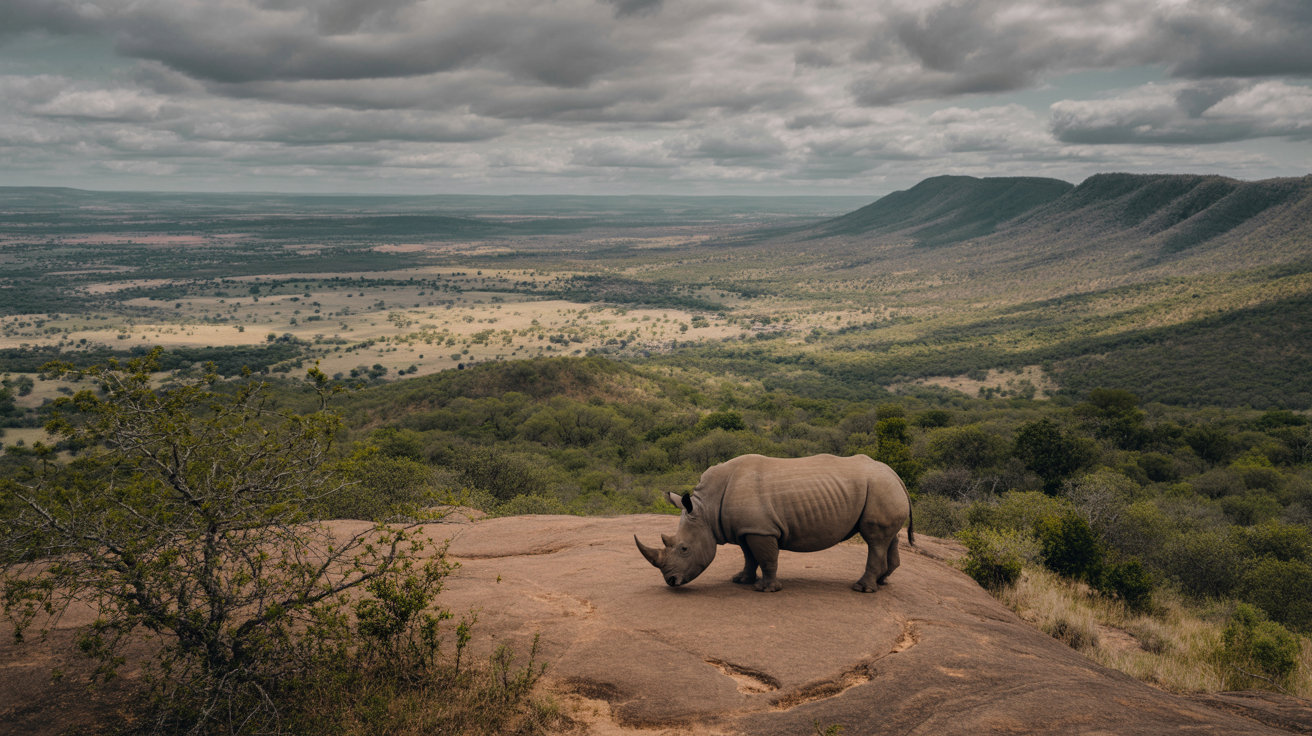
South Africa's rhino heartland. Kruger and Pilanesberg both have significant white rhino populations and smaller black rhino numbers. Due to poaching pressures, exact numbers are no longer published, but both parks invest heavily in anti-poaching operations. In our experience, white rhino sightings are excellent in both parks — Pilanesberg perhaps slightly more reliable for casual visitors because the animals concentrate around waterholes in the compact reserve.
Buffalo
Kruger has enormous herds of Cape buffalo, sometimes 500+ strong, moving across the open grasslands of the central and southern sections. It is genuinely dramatic. Pilanesberg has buffalo too, but in smaller herds. If seeing a massive buffalo herd is on your list, Kruger is the place.
Beyond the Big Five
Kruger's extraordinary biodiversity includes cheetah, wild dog (painted wolf), hippo, giraffe, zebra, hyena, crocodile, and over 500 bird species. Wild dog sightings have improved dramatically in recent years, and Kruger is one of the best places in Africa to see this endangered predator.
Pilanesberg has all of those except wild dog (they were removed due to the reserve's size constraints) and has notably good hippo viewing at Mankwe Dam and white rhino sightings along the western roads.
Our honest take: For pure Big Five probability and biodiversity, Kruger wins. But Pilanesberg punches well above its weight for a reserve its size, and its concentrated layout means you often see more animals per hour of driving. If you only have a few hours, Pilanesberg's hit rate is impressive.
Malaria: The Elephant in the Room
Let me address this directly because it shapes many visitors' decisions.
Pilanesberg is malaria-free. Full stop. It sits in the North West Province, well outside the malaria belt. No prophylaxis needed, no mosquito anxiety, no health concerns whatsoever. For families with young children, pregnant women, or travellers who prefer zero malaria risk, this is a significant advantage.
Kruger falls within a malaria-risk area, particularly in the wet summer months (October to April). The risk is classified as low to moderate and has decreased significantly over the decades thanks to control programmes. Most visitors take prophylaxis (Malarone is the most common — around R800 for a course), use insect repellent, and wear long sleeves at dusk. In the dry winter months (June to September), the risk drops dramatically, and many seasoned travellers to the southern camps skip prophylaxis entirely (though we always recommend consulting your doctor).
Our honest take: For health-conscious travellers, especially families with small children, Pilanesberg's malaria-free status is a genuine advantage. For most healthy adults willing to take standard precautions, Kruger's malaria risk is manageable and should not deter you from an extraordinary safari experience. We have taken thousands of guests to Kruger and malaria has never been an issue.
Costs: The Real Numbers (2026 ZAR)
Let us talk money — honestly.
Park Entry Fees (Conservation Levies)
| Kruger (SANParks) | Pilanesberg | |
|---|---|---|
| South African adults | R110 per person/day | R50 per person/day |
| International adults | R440 per person/day | R120 per person/day |
| Children (2–11) | R70 / R220 (SA/Int.) | R25 / R60 (SA/Int.) |
| Vehicle fee | None (included) | None |
Accommodation
Kruger SANParks rest camps: From R1,200/night for a basic hut to R3,500/night for a family cottage. Self-catering.
Kruger private lodges (Sabi Sands, Timbavati etc.): From R8,000/night to R50,000+/night all-inclusive with guided game drives.
Pilanesberg accommodation: From R800/night for budget chalets to R6,000+/night at luxury resorts. The nearby Sun City adds another layer of resort options from R2,500/night.
Guided Safari Costs (from Johannesburg with Bakubung Safaris)
| Experience | Estimated Cost |
|---|---|
| Pilanesberg full-day safari | From R1,800 per person |
| Pilanesberg overnight safari | From R3,500 per person |
| Kruger 2-night guided safari | From R6,500 per person |
| Kruger 3-night lodge experience | From R12,000 per person |
| Sabi Sands 2-night luxury | From R18,000 per person |
Prices vary by season, group size, and accommodation tier. Contact us for a personalised quote.
Our honest take: Pilanesberg is significantly cheaper for a day out, making it the best-value Big Five experience in South Africa. Kruger's multi-day trips cost more in total but deliver an exponentially deeper safari experience — and the per-day value of Kruger's SANParks accommodation is outstanding. Both parks offer extraordinary value compared to East Africa or Botswana.
Self-Drive vs Guided: Which Park Suits Which Style?
Both parks are excellent for self-driving, but the experience differs.
Kruger has an extensive network of tarred and well-maintained gravel roads (over 2,500 km of them). You can self-drive in a standard rental car. The road system is well-signposted, and the park provides excellent maps. Self-driving Kruger is one of Africa's great road trips — you set your own pace, stop when you want, and there is a thrilling sense of independence as you scan the bush for movement. The downside: Kruger is so vast that without local knowledge, you might drive for hours through beautiful but quiet bush. A good guide knows where the animals move.
Pilanesberg has a compact, well-maintained road network (about 100 km of roads) that you can cover thoroughly in a single day. The signage is clear, the loops are logical, and because the park is smaller, you are almost always near a waterhole or known game area. Pilanesberg is arguably the easiest self-drive Big Five park in South Africa — perfect for beginners.
For guided safaris from Johannesburg, we run both destinations and can tell you: a guide adds more value in Kruger (where local knowledge of animal movements across the vast park makes a dramatic difference) than in Pilanesberg (where the compact layout means you will see most of the same animals whether guided or self-driving). That said, a guide always enhances the experience with interpretation, bush knowledge, and storytelling.
When to Visit: Seasonal Strategies
Best Time for Kruger
Dry winter (May–September): The classic safari season. Vegetation thins out, animals gather at water sources, and game viewing is at its best. Cool mornings (5–15°C), warm days (20–28°C). Lower malaria risk. July and August are peak — book months in advance.
Wet summer (October–April): The bush is lush and green, bird life explodes, and newborn animals appear. It is stunningly beautiful but harder to spot game in the dense vegetation. Afternoon thunderstorms are spectacular. November to February is quietest and cheapest.
Best Time for Pilanesberg
Dry winter (May–September): Same advantages as Kruger — thinner bush, concentrated wildlife, and pleasant temperatures. Because Pilanesberg is in a volcanic crater, its waterholes are particularly reliable in winter, creating exceptional game-viewing hotspots.
Wet summer (October–April): Pilanesberg is beautiful in summer, and because there is no malaria concern, there is less reason to avoid the green season. Game viewing is slightly harder in the dense vegetation, but still rewarding.
Our honest take: Both parks are best in the dry winter months. But if you are visiting in summer, Pilanesberg has the edge for ease of mind — no malaria, shorter drive, and reliable waterhole sightings even when the bush is thick.
The Verdict: Which Safari is Right for You?
After hundreds of trips to both parks, here is my honest guidance:
Choose Pilanesberg if:
- You have one day or a weekend
- You want a malaria-free safari
- You are visiting with young children or health-conscious travellers
- You want the best-value Big Five day trip from Johannesburg
- You are a first-time safari-goer and want an easy, stress-free introduction
- You want to combine your safari with Sun City or a Johannesburg city experience
Choose Kruger if:
- You have two nights or more
- You want the full wilderness immersion — the sounds, the solitude, the scale
- You are chasing specific sightings (wild dog, big cat action, massive elephant herds)
- You want to explore the legendary Sabi Sands or Timbavati private reserves
- You are a self-drive enthusiast who wants Africa's greatest road trip
- You want the widest range of accommodation from budget camping to ultra-luxury
Choose Both if:
Honestly? This is what I recommend to every visitor who has the time. Start with a Pilanesberg day trip on your first or second day — it is a perfect introduction to the bush, close to Joburg, and absolutely thrilling. Then head to Kruger for two or three nights for the deep immersion. You get the best of both worlds, and the contrast between the two parks makes each feel even more special.
We build exactly this kind of combination itinerary for guests every week. Get in touch and let us design your perfect trip.
Let Bakubung Safaris Take You There
Whether you choose Kruger, Pilanesberg, or both — we will make it unforgettable. As a Johannesburg-based operator with FGASA-qualified guides, we run safaris to both parks year-round with honest pricing and a passion for wildlife that runs deeper than any brochure.
Read our detailed guides:
- Kruger National Park Safari Guide 2026
- Pilanesberg National Park Safari Guide 2026
- Kruger vs Pilanesberg for Families
- Sabi Sands Game Reserve Guide 2026
- South Africa Safari Tours: Complete Guide
Ready to book? Request a personalised safari quote or chat with us on WhatsApp — we respond within hours, and we will be honest about which park is right for you.
The bush is calling. Let us answer it together. 🦁