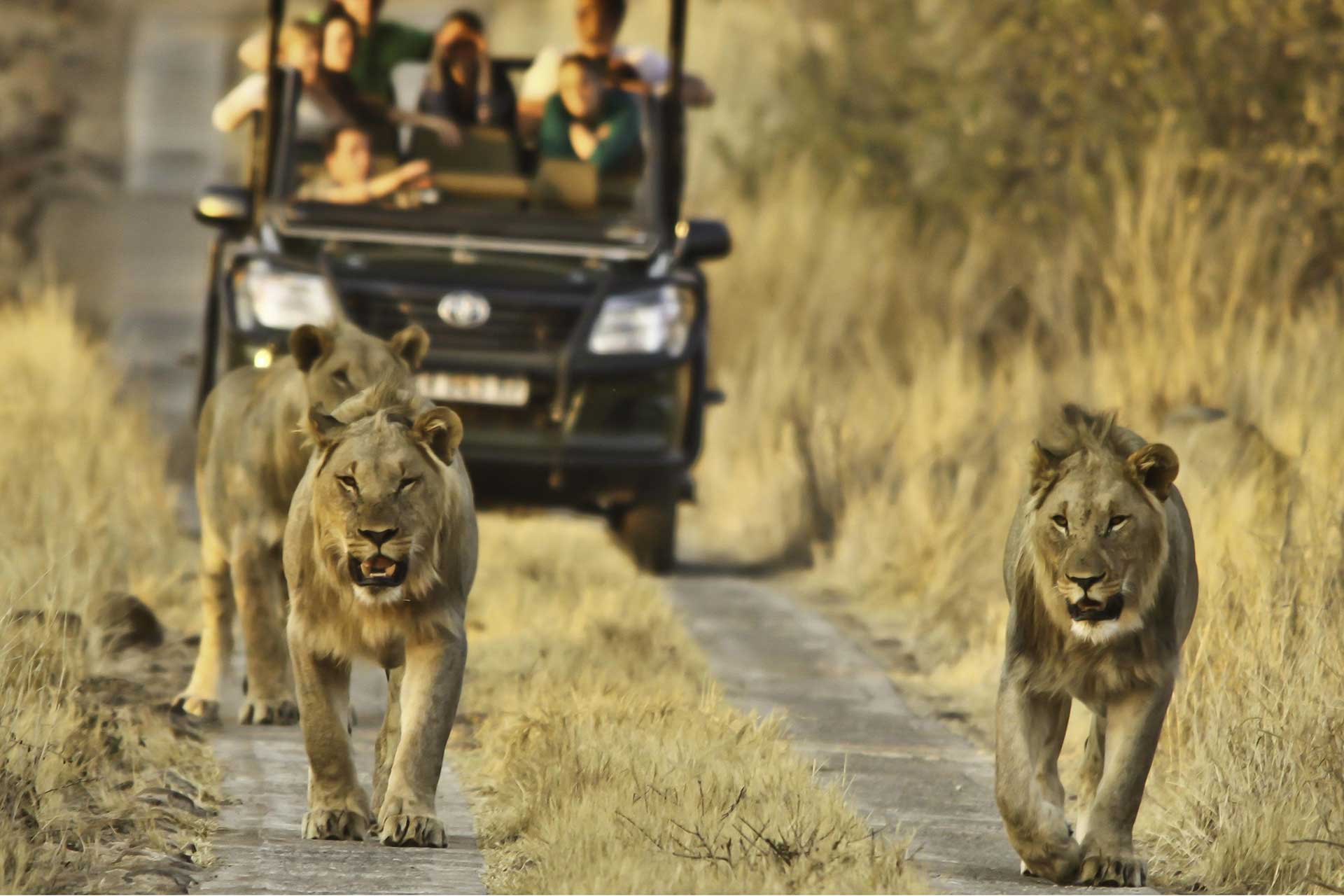
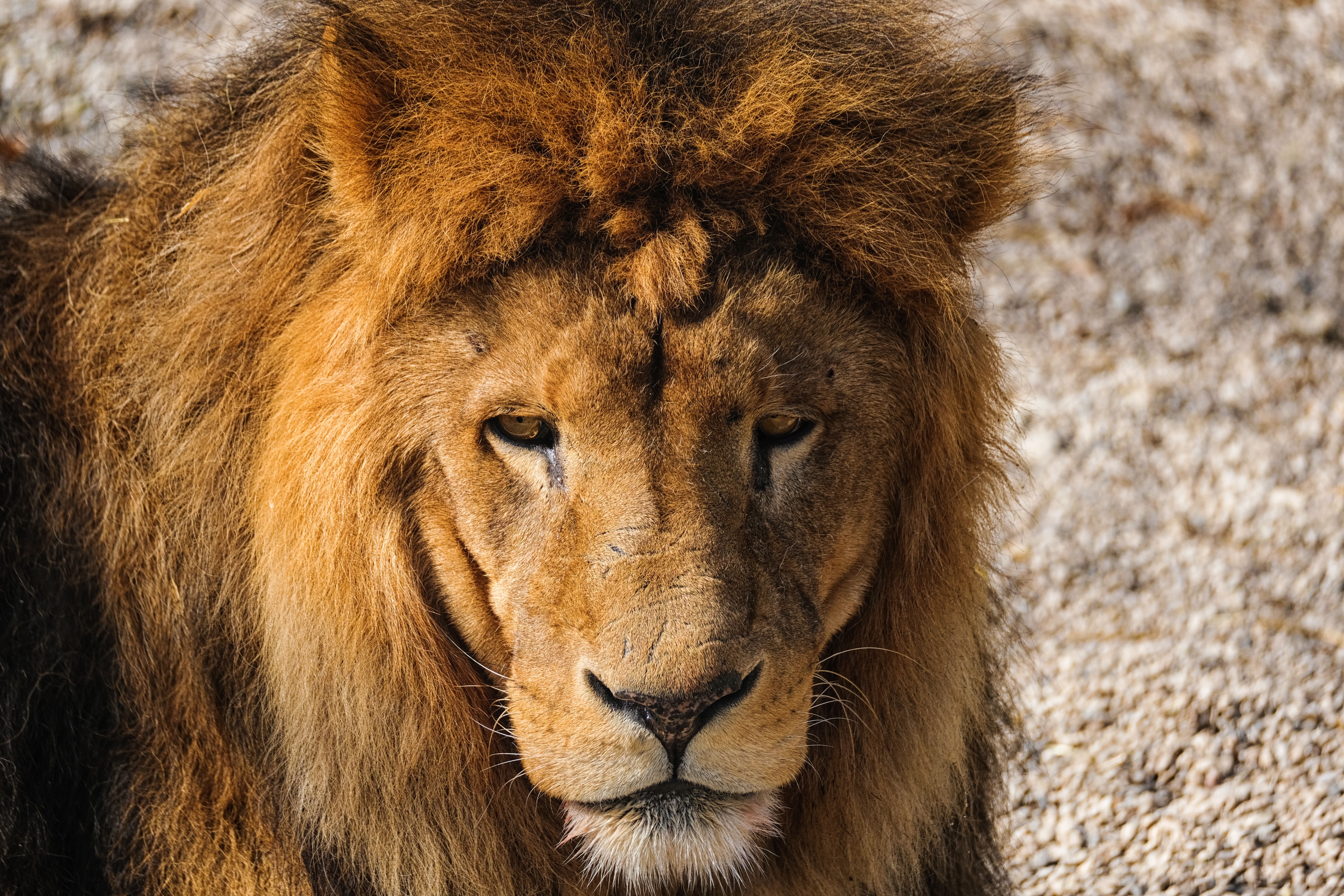
 A magnificent male African lion with a thick golden mane stares directly at the camera — the undisputed king of the Big Five
"Did you see the Big Five?"
It is the first question everyone asks when you come back from a safari. Not "did you have a good time?" Not "was it beautiful?" Just: did you see the Big Five?
The Big Five are the most famous animals in Africa, and the single biggest driver of safari tourism on the continent. But most people know surprisingly little about them beyond the name. Why these five? Where is the best place to see each one? What are your realistic odds? And is ticking all five really the point of a safari?
I have spent years guiding in South Africa's greatest reserves, and I have helped thousands of guests see their first lion, their first leopard, their first elephant charge. Let me give you the complete, honest guide to the Big Five.
What Are the Big Five?
The Big Five are:
- Lion (Panthera leo)
- Leopard (Panthera pardus)
- African Elephant (Loxodonta africana)
- Cape Buffalo (Syncerus caffer)
- Rhinoceros (both White and Black — Ceratotherium simum and Diceros bicornis)
Why These Five?
Contrary to what most people assume, the Big Five were not chosen for their size. Hippos and giraffes are bigger than leopards and buffalo. The name comes from big-game hunting — these were the five animals considered the most dangerous and difficult to hunt on foot in Africa.
The lion for its power and aggression. The leopard for its stealth and cunning. The elephant for its intelligence and fury when wounded. The buffalo for its unpredictable temperament (known as "the Black Death" among hunters). And the rhinoceros for its explosive charge.
Today, the Big Five are a conservation and tourism icon rather than a hunting list. But the name stuck, and it remains the most searched safari term on the internet.
1. The African Lion 🦁
The King
The lion is the animal most people dream of seeing on safari. A full-grown male with a dark mane, lying in golden grass, looking straight at you from 10 metres away — it is an image that stays burned in your memory.
Fast facts:
- Males weigh 190-230 kg; females 120-150 kg
- Lions are the only truly social big cat, living in prides of 5-30
- They sleep up to 20 hours a day (which is why patience matters)
- Kruger has ~1,600 lions; Pilanesberg has ~30-40
Where to See Lions
| Reserve | Lion Population | Your Odds (per day) | Notes |
|---|---|---|---|
| Kruger National Park | ~1,600 | 70-80% | Central Kruger (Satara area) is the lion hotspot |
| Sabi Sands | ~200+ | 85-95% | Off-road driving + expert trackers = almost guaranteed |
| Pilanesberg | ~30-40 | 40-50% | Smaller reserve, but sightings are regular |
| Madikwe | ~100+ | 60-70% | Excellent lion viewing, malaria-free |
How to Spot a Lion
- Look in the shade. Lions rest under large trees, in tall grass, or against termite mounds during the heat.
- Scan the road edges at dawn. Lions use tar roads as walking paths at night and are often still on or near roads at first light.
- Watch the prey animals. If impala are staring intently in one direction with their ears forward, a predator is there.
- Listen. A lion's roar carries 8 km. If you hear one at night from your rest camp, drive that direction at first light.
2. The African Leopard 🐆
The Ghost
The leopard is the hardest of the Big Five to see — and therefore the most prized sighting. Solitary, nocturnal, and impossibly well-camouflaged, a leopard can be lying on a branch 5 metres above your head and you will not see it unless someone points it out.
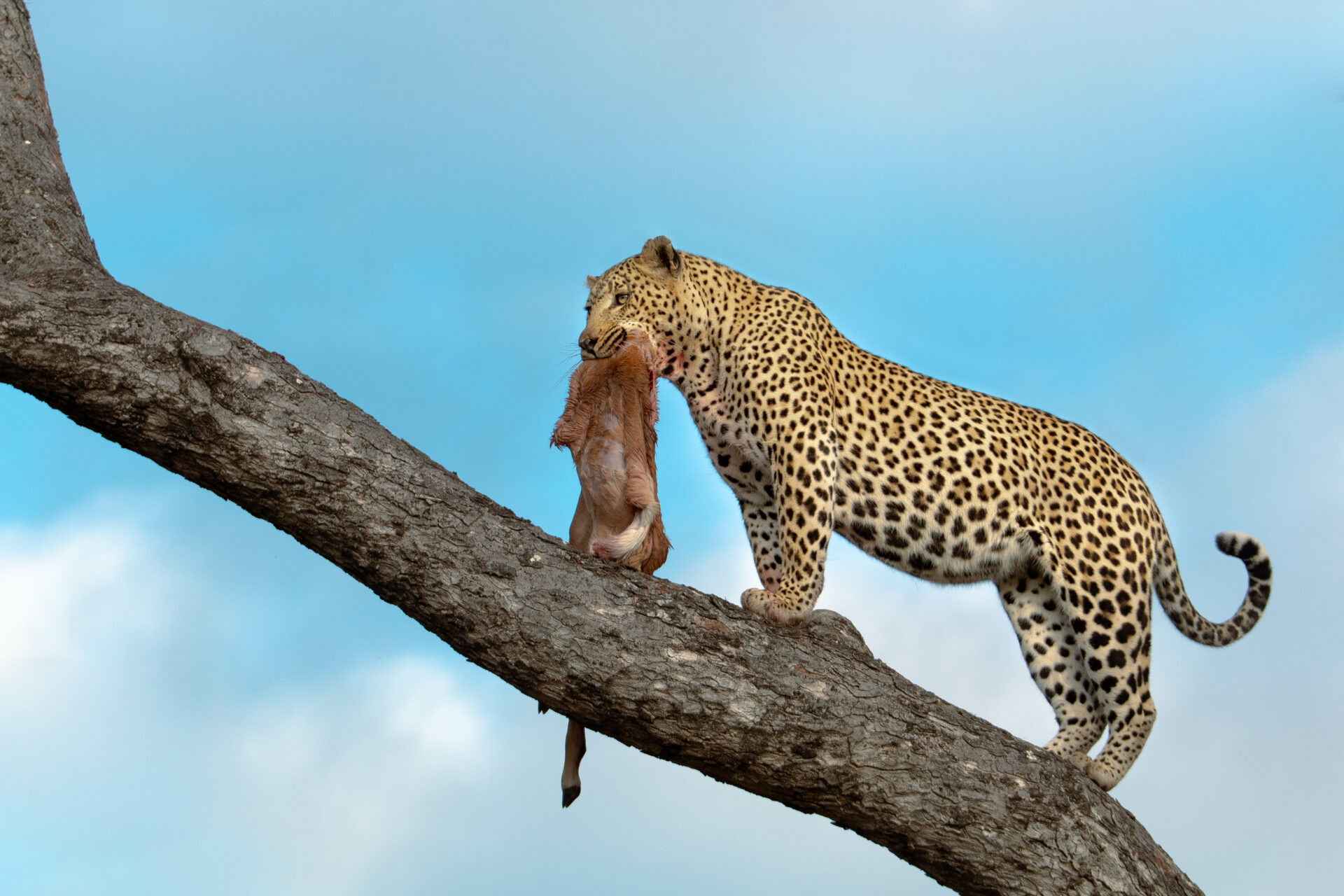 A leopard carries its kill up a tree branch against a bright blue sky — the classic Big Five sighting that every safari-goer dreams of
Fast facts:
- Males weigh 60-90 kg; females 30-60 kg
- Leopards are solitary and territorial
- They hoist kills into trees to keep them from lions and hyenas
- Kruger has ~1,000 leopards; Sabi Sands has the highest density in Africa
Where to See Leopards
| Reserve | Your Odds (per day) | Notes |
|---|---|---|
| Sabi Sands | 80-90% | The leopard capital of the world. Habituated leopards allow close approach |
| Kruger (southern section) | 30-40% | Along rivers and rocky outcrops. Look UP into trees |
| Pilanesberg | 15-25% | Less common but regular. Rocky areas near Mankwe Dam |
| Londolozi (Sabi Sands) | 90%+ | Arguably the best leopard viewing on Earth |
How to Spot a Leopard
- Look UP. Leopards rest in trees during the day. Scan the branches of large jackalberry and marula trees.
- Check rocky outcrops (kopjes). Leopards love lying on warm rocks.
- Drive along rivers. Riverine forest is prime leopard habitat.
- Night drives. Leopards are most active after dark. Night drives with a spotlight dramatically increase your odds.
- Follow the alarm calls. Vervet monkeys, baboons, and impala alarm-call when a leopard is near. Listen for the distinctive bark.
3. The African Elephant 🐘
The Gentle Giant
Elephants are the easiest of the Big Five to see and arguably the most emotionally impactful. Watching a breeding herd cross a river, baby tucked between its mother's legs, while the matriarch leads with quiet authority — it hits something deep.
Fast facts:
- The largest land animal on Earth (bulls up to 6,000 kg)
- Highly intelligent, with complex social structures and demonstrated grief/empathy
- Kruger has ~20,000 elephants; Pilanesberg has ~250
- They eat up to 200 kg of vegetation per day
Where to See Elephants
Honest truth: everywhere. Elephants are the one Big Five member you are almost guaranteed to see at any major South African reserve.
| Reserve | Elephant Population | Your Odds (per day) |
|---|---|---|
| Kruger | ~20,000 | 95%+ |
| Pilanesberg | ~250 | 85-90% |
| Addo Elephant Park | ~600 | 99% |
| Sabi Sands | Shared with Kruger | 90%+ |
The Best Elephant Experiences
- Waterholes at sunset — Elephants drink, splash, and socialise. Lower Sabie in Kruger and Mankwe Dam in Pilanesberg are legendary.
- River crossings — When a breeding herd crosses a river, the babies sometimes disappear completely underwater. It is terrifying and adorable in equal measure.
- Bull elephants in musth — A bull in musth (heightened testosterone) is one of the most impressive and dangerous sights in the bush. Give them space.
4. The Cape Buffalo 🐃
The Black Death
Buffalo do not have the glamour of lions or the elegance of leopards. But ask any experienced guide which animal they respect the most, and the answer is usually buffalo.
They are unpredictable, intelligent, and have killed more hunters than any other African animal. A buffalo herd 500 strong, moving across the landscape in a cloud of dust, is one of the most awe-inspiring sights on safari.
Fast facts:
- Adults weigh 700-900 kg
- Herds can number 500-1,000+ individuals
- Old bulls ("dagga boys") live alone or in small bachelor groups and are the most dangerous
- Kruger has ~40,000 buffalo; Pilanesberg has ~200
Where to See Buffalo
| Reserve | Your Odds (per day) | Notes |
|---|---|---|
| Kruger | 80-90% | Massive herds in the central and northern sections |
| Pilanesberg | 70-80% | Smaller herds, but regular sightings |
| Sabi Sands | 80%+ | Often seen at waterholes |
| Hluhluwe-iMfolozi | 85%+ | Historic buffalo stronghold |
The Buffalo Moment
The sighting that stays with you: a dagga boy (old bull) standing alone at a waterhole, caked in mud, horns worn and scarred, staring at you with that flat, calculating expression that says "I have killed things bigger than you." It is humbling.
5. The Rhinoceros 🦏
The Armoured One
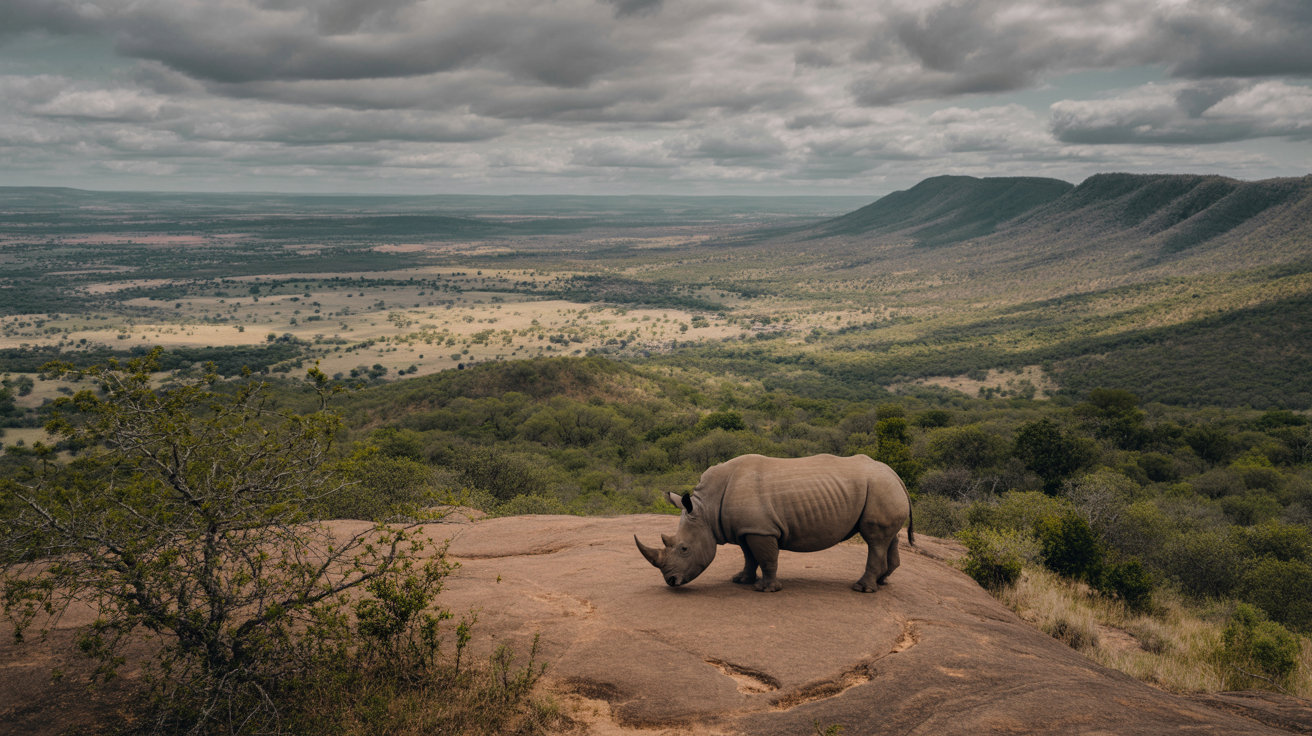
Seeing a rhino in the wild in 2026 is a privilege. Poaching has devastated populations across Africa, and every rhino sighting carries an emotional weight that the other Big Five members do not.
South Africa is home to ~80% of the world's remaining white rhinos and a significant population of critically endangered black rhinos.
Fast facts:
- White rhino: 1,800-2,500 kg, grazer, relatively docile, wide square lip
- Black rhino: 900-1,350 kg, browser, more aggressive, hooked lip
- "White" has nothing to do with colour — it comes from the Dutch "wijd" (wide), describing the mouth shape
- Kruger has ~3,500 white rhinos and ~500 black rhinos
Where to See Rhinos
| Reserve | Species | Your Odds (per day) | Notes |
|---|---|---|---|
| Pilanesberg | White + Black | 60-70% | One of the best places for both species |
| Kruger (southern) | White + Black | 50-60% | Southern section between Skukuza and Lower Sabie |
| Hluhluwe-iMfolozi | White + Black | 70-80% | Birthplace of rhino conservation |
| Sabi Sands | White + Black | 50-60% | Less common but regular |
How to Spot a Rhino
- White rhinos graze on open grasslands. Look for large grey shapes in clearings.
- Black rhinos browse in thicker bush and are harder to spot. Dawn and dusk are best.
- Waterholes at dusk — Rhinos visit water regularly. Stake out a hide or waterhole viewpoint.
- Listen for oxpeckers — The red-billed oxpecker is almost always found on rhinos. A flock of oxpeckers flying up from the bush often signals a rhino below.
Your Realistic Odds: Can You See All Five?
| Duration | Reserve | All 5 Odds |
|---|---|---|
| Day trip | Pilanesberg | 20-30% |
| Day trip | Kruger (guided) | 30-40% |
| 3-day safari | Kruger | 70-80% |
| 3-day safari | Sabi Sands | 85-95% |
| 5-day safari | Kruger + Sabi Sands | 95%+ |
The animal most often "missing" is the leopard. Everything else you will very likely see in 2-3 days at any major reserve. The leopard is the one that requires luck, patience, or a Sabi Sands lodge.
Beyond the Big Five
Here is my honest opinion: the Big Five checklist can actually diminish your safari experience.
I have watched guests see 4 of the 5, have an incredible day, and then call it "disappointing" because they missed the leopard. Meanwhile, they saw a pack of wild dogs (rarer than any Big Five member), a fish eagle catching a bream, and a baby elephant taking its first swim.
The bush is not a checklist. It is an experience. The Big Five are magnificent, but so are the Little Five, the Ugly Five, the birding, the insects, the landscapes, the silence.
Come for the Big Five. Stay for everything else.
Your Big Five Safari Starts Here
Whether you want a single-day taste or a week-long immersion, we will put you in front of Africa's greatest wildlife.
- Pilanesberg Day Safari — From R1,800/person. Big Five, malaria-free, from Johannesburg.
- Kruger 3-Day Safari — From R6,649/person. Maximum Big Five odds.
- Read: Kruger vs Pilanesberg Comparison — Which reserve is right for you?
- Read: Self-Drive vs Guided Safari — How you travel changes what you see.
- Read: First Safari? 15 Tips — Be prepared.
📱 WhatsApp Thabo — Tell me which Big Five member you want most. I will get you there.
🦁🐆🐘🐃🦏 Five animals. One continent. Your lifetime.
— Thabo Makate, Bakubung Safaris & Tours