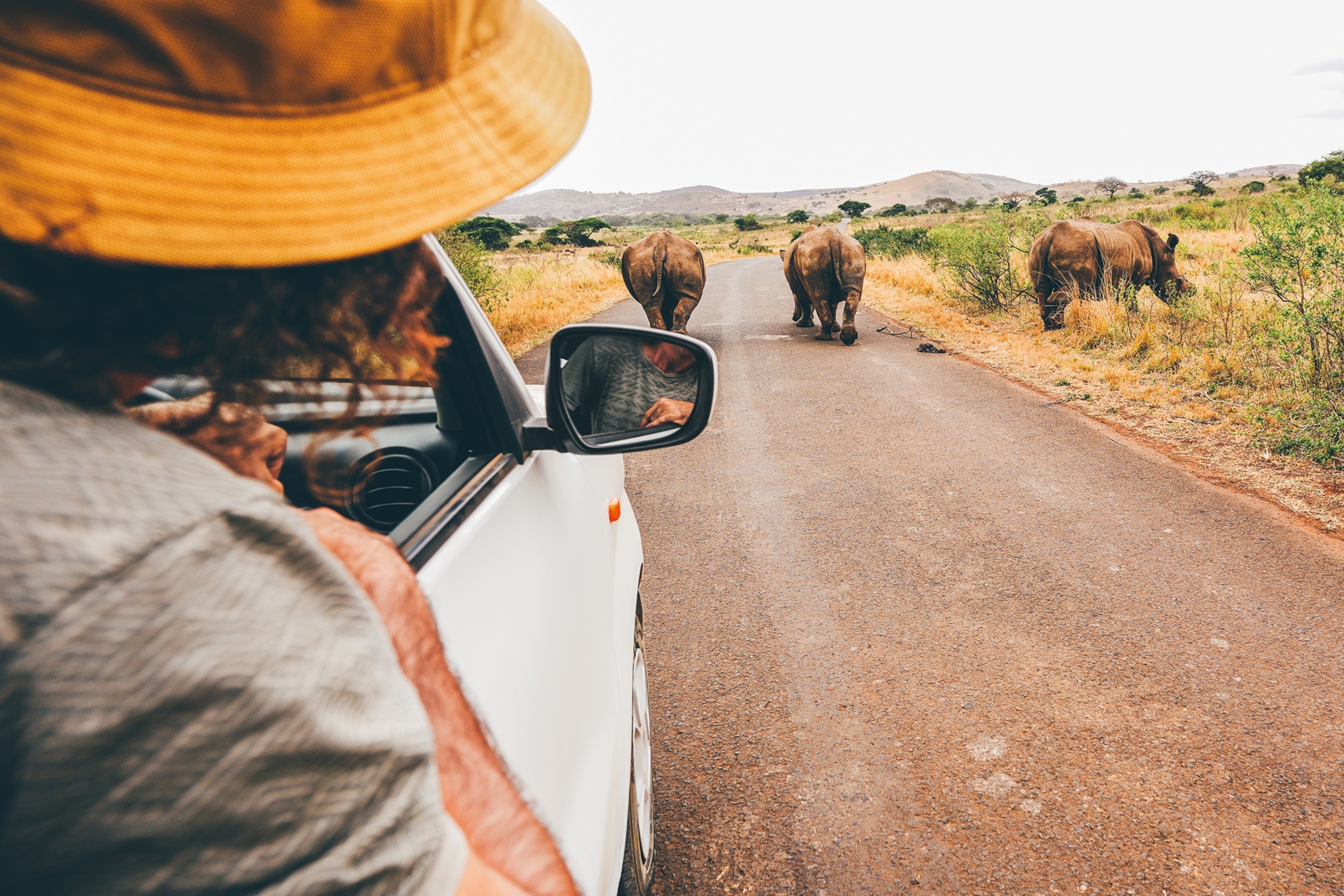
 A traveller watches rhinos walk down a road from their rental car — the thrill of a South African self-drive safari
Few decisions shape your South African safari more than this one: do you drive yourself, or let a professional guide take the wheel?
It sounds simple, but the answer changes everything — your budget, your wildlife encounters, your daily rhythm, and the very feeling of being in the bush. I have spent years doing both, guiding clients through Kruger and Pilanesberg while also sneaking away on personal self-drive trips whenever I get the chance. Both have made me fall deeper in love with the African bush. Both have given me moments I will never forget.
But they are fundamentally different experiences, and picking the wrong one for your trip can leave you disappointed. So let me give you the honest breakdown — no sales pitch, just the truth from someone who does this for a living.
Self-Drive Safari: Freedom on Four Wheels
What It Means
A self-drive safari means you rent a car (or use your own vehicle), drive into the national park or game reserve, and explore independently. You follow the park's road network, stop wherever you like, and find your own wildlife sightings. In South Africa, several major reserves allow self-driving, with Kruger National Park being the gold standard.
You do not need a 4x4 — a standard rental car (even a small hatchback) handles Kruger's tarred roads perfectly, and most gravel roads are manageable in a sedan. You pay park entry fees, follow the speed limits (50 km/h on tar, 40 km/h on gravel, 20 km/h in camps), and stay in your vehicle at all times outside designated rest areas.
The Magic of Self-Drive
There is a feeling you only get on a self-drive safari. It is 5:45am. The gate has just opened. You are driving slowly along a gravel road with the windows down, cold bushveld air rushing in, and the only sound is gravel crunching under your tyres and a Burchell's coucal calling from the riverbed. Then you round a corner and there they are — two lionesses with four cubs, lying in the road, yawning in the first light.
You found them. Not a guide. Not a tracker on a radio. You.
That sense of personal discovery is irreplaceable. Every sighting feels earned, every corner holds possibility, and the excitement of not knowing what is around the next bend is genuinely addictive. This is why self-drive safari has a devoted global following.
Best Parks for Self-Driving
- Kruger National Park — The ultimate self-drive destination. Over 2,500 km of roads, excellent infrastructure, and world-class Big Five wildlife.
- Pilanesberg Game Reserve — Compact, easy to navigate, malaria-free, and perfect for a day trip from Johannesburg.
- Addo Elephant National Park — Eastern Cape gem, famous for enormous elephant herds and malaria-free Big Five.
- Hluhluwe-iMfolozi Park — KwaZulu-Natal's Big Five reserve, excellent roads and rhino populations.
- Kgalagadi Transfrontier Park — Remote and dramatic, famous for black-maned Kalahari lions and cheetah.
Self-Drive Costs (2026 ZAR)
| Expense | Estimated Cost |
|---|---|
| Car rental (compact, per day) | R450 – R800 |
| Fuel (per day, ~200 km) | R300 – R500 |
| Kruger entry (international adult) | R440 per day |
| Kruger entry (SA adult) | R110 per day |
| Pilanesberg entry (international) | R120 per day |
| SANParks chalet (per night) | R1,200 – R3,500 |
| SANParks camping (per night) | R350 – R550 |
| Food (self-catering, per person) | R200 – R400 per day |
Total for a 3-night Kruger self-drive (couple, international): Approximately R8,000 – R15,000 all-in, depending on accommodation choice.
That is extraordinary value for a Big Five safari. Nowhere else in Africa can you do this.
Self-Drive Limitations
Let me be honest about what you miss:
- No off-road driving — you are restricted to the park's road network, so animals even 50 metres from the road remain at a distance
- No expert interpretation — you might see tracks in the road and have no idea what made them
- Early mornings are harder — you need to be at the gate when it opens (times vary seasonally, roughly 5:30–6:00am)
- Sighting competition — popular sightings attract multiple vehicles, and without radio networks, you are relying on luck and road reports at rest camps
- Quieter areas can feel empty — in Kruger's vast northern section, you might drive for two hours and see only impala
- Photography limitations — shooting from a sedan window at road distance produces different results than a guided open vehicle positioned 10 metres from a leopard
Guided Safari: Expert Eyes in the Bush
What It Means
A guided safari means a professional guide (and often a tracker) takes you into the reserve in a specialised open game-drive vehicle. On private reserves like Sabi Sands, Timbavati, or Madikwe, guides can drive off-road to track and approach animals. On SANParks guided drives within Kruger, you stay on roads but benefit from an expert's knowledge of animal behaviour, ecology, and the specific area.
Guided safaris range from budget group drives (6–10 guests sharing a vehicle) to exclusive private vehicle experiences (just your group with a dedicated guide and tracker).
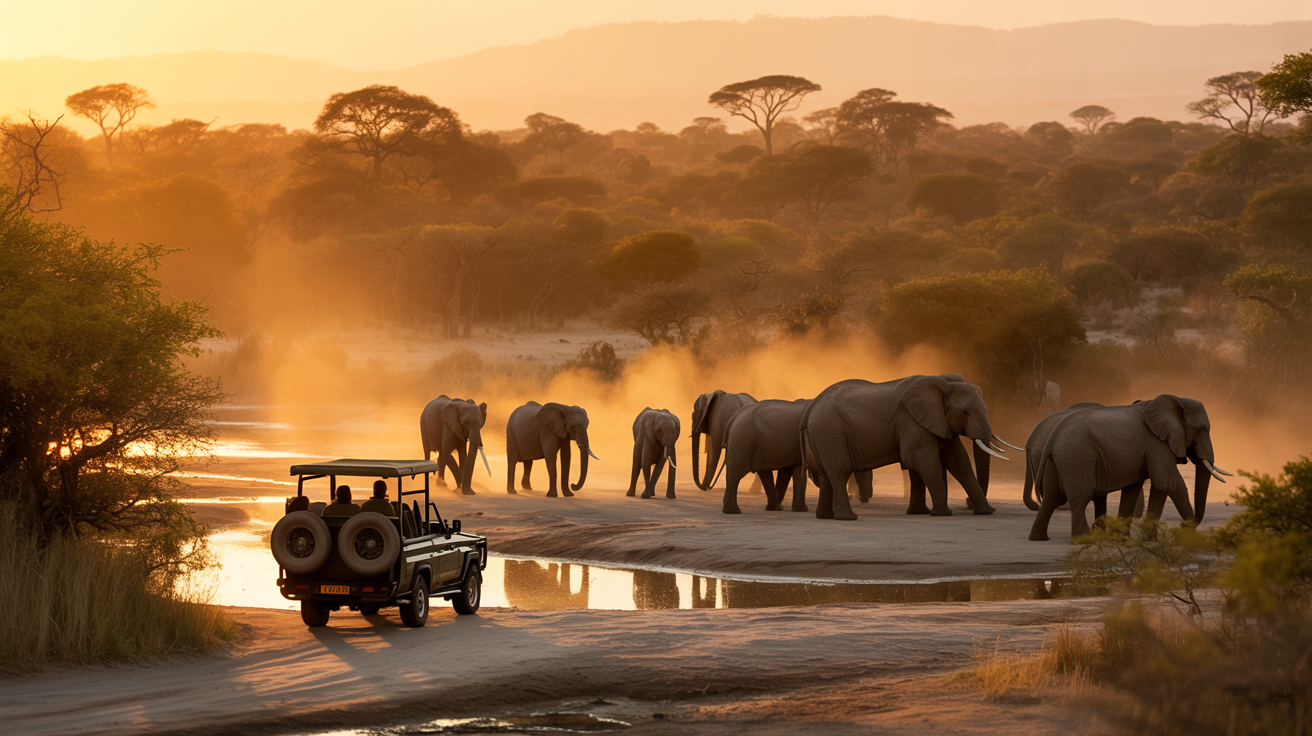
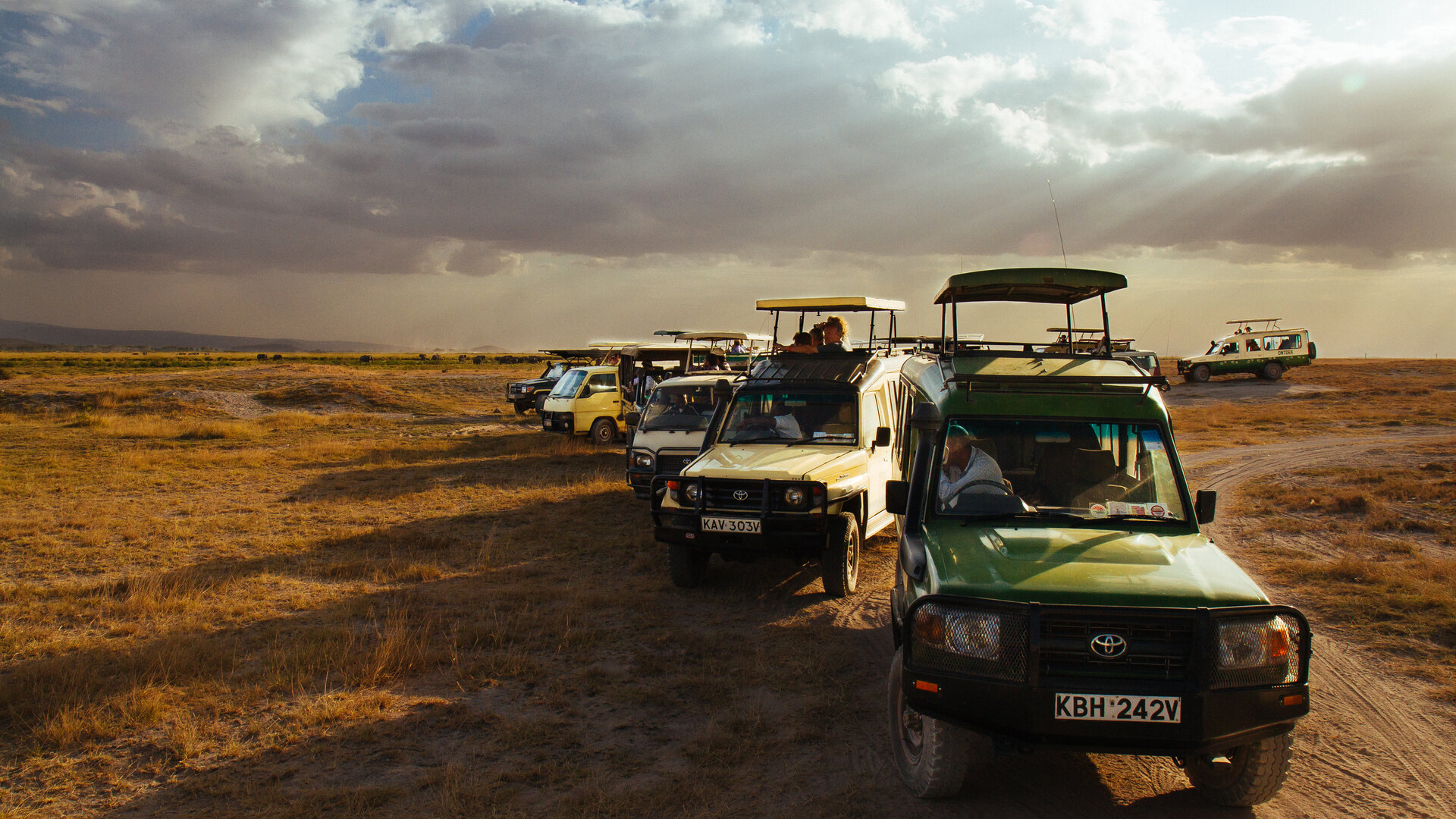 Safari vehicles lined up on the golden savanna — guided game drives with expert trackers who know exactly where to find the wildlife
The Magic of Being Guided
A great guide transforms a safari from "looking at animals" into understanding a living ecosystem. Your guide reads the bush like a book — the alarm call of an impala means a predator is close, the broken branch means elephants passed recently, the circling vultures mean there is a kill nearby.
On a guided drive in Sabi Sands, I watched a tracker spot leopard pugmarks in soft sand, follow them for fifteen minutes through the bush, and lead us to a female leopard feeding on an impala carcass in a drainage line — invisible from any road. That is the power of expert tracking.
Guided drives also operate at the golden hours — leaving before sunrise and returning after sunset — when predators are most active. Self-drivers are restricted to park gate hours and miss these magical twilight moments.
Types of Guided Safari
SANParks Guided Drives (inside Kruger):
- Morning drive (~3 hours): R350–R500 per person
- Sunset drive (~3 hours): R350–R500 per person
- Night drive (~2 hours): R300–R400 per person
- Departing from rest camps in shared open vehicles (10–20 guests)
- On-road only, but ranger knows the area intimately
Private Reserve Lodge Drives (Sabi Sands, Timbavati, Madikwe etc.):
- Twice daily (morning + sunset), 3–4 hours each
- Private vehicle with your guide and tracker (max 6 guests)
- Off-road driving permitted
- Included in lodge rate (typically R5,000–R50,000+ per person per night all-inclusive)
Operator-Led Guided Tours from Johannesburg (what we offer at Bakubung Safaris):
- Full-day Pilanesberg safari: from R1,800 per person
- Multi-day Kruger guided tour: from R6,500 per person (2 nights)
- Open vehicle, qualified FGASA guide, all logistics handled
- View our safari options
Guided Safari Limitations
- Cost — significantly more expensive than self-driving
- Less flexibility — you follow the guide's schedule and route decisions
- Group dynamics — on shared drives, your interests may differ from other guests' (one person wants to watch a dung beetle for ten minutes; another wants to find lions)
- Some people feel passive — if you are the type who loves being behind the wheel, being a passenger may feel less adventurous
The Honest Comparison Table
| Factor | Self-Drive | Guided |
|---|---|---|
| Cost (per day) | R1,200 – R2,500 | R3,500 – R25,000+ |
| Wildlife knowledge | Your own + guidebooks | Expert guide + tracker |
| Off-road access | No (roads only) | Yes (private reserves) |
| Flexibility | Total — go where you want | Guide-directed |
| Predator sightings | Good (luck-dependent) | Excellent (tracked) |
| Photography quality | Road distance, sedan height | Close range, elevated position |
| Dawn/dusk drives | Limited to gate hours | Before sunrise, after sunset |
| Night drives | Not possible (self-drive) | Available |
| Best for | Adventurers, budget, repeat visitors | First-timers, special occasions, photographers |
| Effort required | High (plan, navigate, spot) | Low (everything handled) |
Who Should Choose What?
Choose Self-Drive if:
- You love driving and exploring independently
- You are on a budget and want maximum value
- You are a repeat visitor who knows the parks
- You have flexible time (3+ days) to explore at your pace
- You enjoy the thrill of finding your own sightings
- You are visiting Kruger or Pilanesberg (where self-drive infrastructure is excellent)
Choose Guided if:
- You are a first-time safari visitor and want to maximise sightings
- You want expert interpretation of animal behaviour and ecology
- You are celebrating a special occasion and want everything handled
- Photography is a priority (guided vehicles position for the best angles)
- You want predator close encounters (especially leopard in Sabi Sands)
- You prefer dawn and dusk drives when wildlife is most active
- You do not want to deal with logistics (routes, accommodation, food)
Choose Both if:
This is my favourite recommendation. Combine two or three nights of self-driving in Kruger's main camps with a guided day trip to Pilanesberg or a night in a private lodge. You get the independence and adventure of self-driving plus the expert encounters of a guided experience. The contrast between the two styles makes both feel richer.
We design these combination trips regularly — get in touch and we will build one for you.
Our Honest Take
After years on both sides of the equation — as a guide showing clients the bush, and as a self-driver exploring for my own joy — here is my truth:
Self-driving gives you freedom. The road is yours, the discoveries are yours, and the bush feels wild and unpredictable in a way that nothing else replicates. It is also astonishingly affordable.
A guided safari gives you depth. A great guide opens your eyes to an entire world you would walk (or drive) straight past. The stories, the tracking skills, the positioning for photography, the night sounds explained — it enriches every moment.
Neither is "better." They are different doors into the same cathedral.
The bush does not care how you arrive. It will welcome you either way. 🦁
Further Reading
- Kruger vs Pilanesberg: The Honest Safari Comparison
- Sabi Sands vs Kruger: Is the Luxury Upgrade Worth It?
- Kruger National Park Safari Guide 2026
- Pilanesberg National Park Safari Guide 2026
- Budget Safari South Africa Guide
Ready to book your safari — self-drive, guided, or both? Request a personalised quote or chat with us on WhatsApp. We will help you choose the style that fits your trip perfectly. 🚙🦁